A near miss can feel like luck. Then the next day happens, and luck runs out. Standards turn “hope it works” into repeatable results you can verify.
In plain terms, standards are agreed-upon rules for how to design, build, test, and manage work. When standards improve safety, they cut risks before injuries happen. When quality standards benefits kick in, customers get more consistent products, fewer defects, and steadier performance.
You do not need a standards department to see the impact. You just need clear rules, checks that catch issues early, and a way to keep improving. That’s what you’ll learn here, from how standards prevent accidents to how they show up in real industries like factories, hospitals, and aviation.
Next, let’s break down the mechanisms that make standards work.
How Standards Set Clear Rules to Prevent Accidents and Errors
Think of standards like a sturdy playbook. Teams still have to think, but they don’t start each game from scratch.
Good standards cover the “what” and the “how” in everyday decisions. They spell out design rules, material requirements, testing steps, and documentation needs. They also push organizations to look for risks, fix gaps, and keep records so the same problem doesn’t sneak back in.
Here are the core ways standards reduce defects and improve safety:
- Uniform rules for design and testing: When everyone uses the same acceptance criteria, fewer items slip through. That means fewer failures later.
- Built-in audits and continuous improvement: Checks find weak spots early. Updates then close those gaps before they grow.
- Compliance you can measure: Standards make it easier to prove you’re meeting requirements. That reduces wasted work and costly rework.
- Trust through certifications: Certifications act like a signal to buyers. They show the process follows a known, tested approach.
If you want a quick map of how this connects to results, here’s a simple view.
| Standards mechanism | What it targets | Typical safety and quality result |
|---|---|---|
| Clear requirements | Unclear “best effort” work | Fewer errors and safer processes |
| Standard testing | Guesswork in inspection | More reliable outcomes, fewer defects |
| Training and documentation | Skill drift across shifts | Consistent work quality every time |
| Risk-based reviews (like ISO 45001) | Known and unknown hazards | Earlier fixes, fewer incidents |
| Certification and audits | Weak compliance controls | Buyer confidence and fewer surprises |
In the quality world, ISO 9001 provides a management framework that helps organizations standardize processes and improve performance. For safety and worker protection, ISO 45001 pushes planned risk management instead of reacting after something goes wrong. If you want a deeper look at why this approach matters, see the benefits of ISO 9001 quality management.
Standards don’t just create rules. They connect those rules to evidence, training, and follow-up actions. That’s where the safety and quality gains start to show.
Consistency That Keeps Things Reliable Every Single Time
Most quality problems aren’t random. They’re often the result of small changes in setup, training, or inspection habits.
Standards reduce variation. That means one worker’s “close enough” becomes another worker’s “this exact spec.” Over time, the product behaves the same way, not just in theory.
Picture baking cookies. If one person bakes for 8 minutes at 350°F, and another bakes for 12 minutes at 375°F, you won’t get the same cookie. Standards do the same kind of controlling for work processes, tools, and acceptance criteria.
In manufacturing, consistency matters even more because tiny differences can create big risks. For example, electronics depend on repeatable soldering, inspection, and workmanship criteria. That’s where IPC standards come in as common language for board quality and reliability. If you need a practical explanation, check IPC standards demystified.
Here’s what consistency changes in real life:
- Fewer items fail inspection on the last step.
- Rework drops because the team stops guessing.
- Safety improves because fewer “improper builds” reach operators or customers.

Consistency also helps with training. When procedures stay stable, new hires learn faster. Then experienced workers don’t get pulled into constant “fix it the old way” behavior.
Next, standards do something even more important. They help you spot trouble before it becomes a crisis.
Ongoing Checks That Catch Problems Early
If standards only told you what to do once, they’d still be helpful. But strong standards go further. They require checks, review cycles, and updates.
That’s why audits matter. A good audit doesn’t exist to punish. It exists to surface patterns. It asks: where do defects start, and where do hazards hide?
Safety-focused standards, like ISO 45001, push organizations toward planned risk management. Instead of waiting for incidents, teams identify hazards, assess risk levels, and then put controls in place. They also re-check those controls as work conditions change.
For many companies, this becomes a steady rhythm:
- Set requirements and train people.
- Monitor work and results.
- Review problems and root causes.
- Update procedures and controls.
- Repeat.
When you do this well, you catch the early signs. A small control gap gets fixed. A near miss triggers a better method. Then injuries never happen.
If you want another viewpoint on how ISO 45001 supports safer workplaces, here’s how ISO 45001 enhances occupational health and safety.
Ongoing checks also support quality. They improve reliability across shifts and suppliers. They also reduce the “mystery failures” that make teams lose confidence.
However, standards don’t just protect what already exists. They can also help teams adopt new tech safely.
Sparking Smart Ideas Without Cutting Corners
People often fear standards will slow innovation. But the best standards do the opposite. They give you a safe starting point, so you can try new ideas without risking basic failures.
A key point: standards can be flexible about solutions. They usually focus on results you must achieve and risks you must control. That means you can explore better tools, better automation, or new inspection methods, while still meeting safety and quality needs.
For example, organizations increasingly use AI and data analysis in quality checks. However, AI still needs rules. Standards help teams define what “good” looks like and how to verify it.
In safety work, the same idea applies to robotics and automation. In 2026, OSHA’s focus on robot safety is moving toward system-wide risk management. That means companies can’t stop at “the robot is safe.” They also need risk assessment for the full setup, energy control procedures, training proof, and validation of safety behaviors.
When teams treat standards as a base layer, they innovate faster. They avoid costly mistakes, missed compliance, and late-stage redesign.
The result feels like this: smarter work, safer work, and less panic during inspections.
Next, let’s look at where these standards show up in the places you rely on most.
Standards Shining in Real Industries from Factories to Hospitals
Standards are only useful if they change outcomes. So, where do you actually see improvements?
You can spot standards in how factories control hazards, how hospitals review errors, how food systems reduce contamination risk, and how aviation programs learn from safety data. Even consumer products like toys reflect standards that limit harmful chemicals.
Here’s a quick table that ties key standards to real-world benefits.
| Industry focus | Standard example | What it improves | Simple real-world example |
|---|---|---|---|
| Quality management | ISO 9001 | Consistent processes and fewer defects | Stable production steps across shifts |
| Worker safety | ISO 45001 | Risk planning and fewer incidents | Better hazard controls and training |
| Electronics reliability | IPC workmanship standards | Repeatable board quality | Fewer rework cycles and field failures |
| Food safety | ISO 22000 (HACCP-based) | Control points across the chain | Less contamination from production to storage |
| Aviation safety | FAA safety programs | Safety learning from reports and data | Faster fixes from real event insights |
| Toy safety | CPSIA requirements | Limits on harmful chemicals | Safer products for kids |
Now let’s make it concrete in each setting.
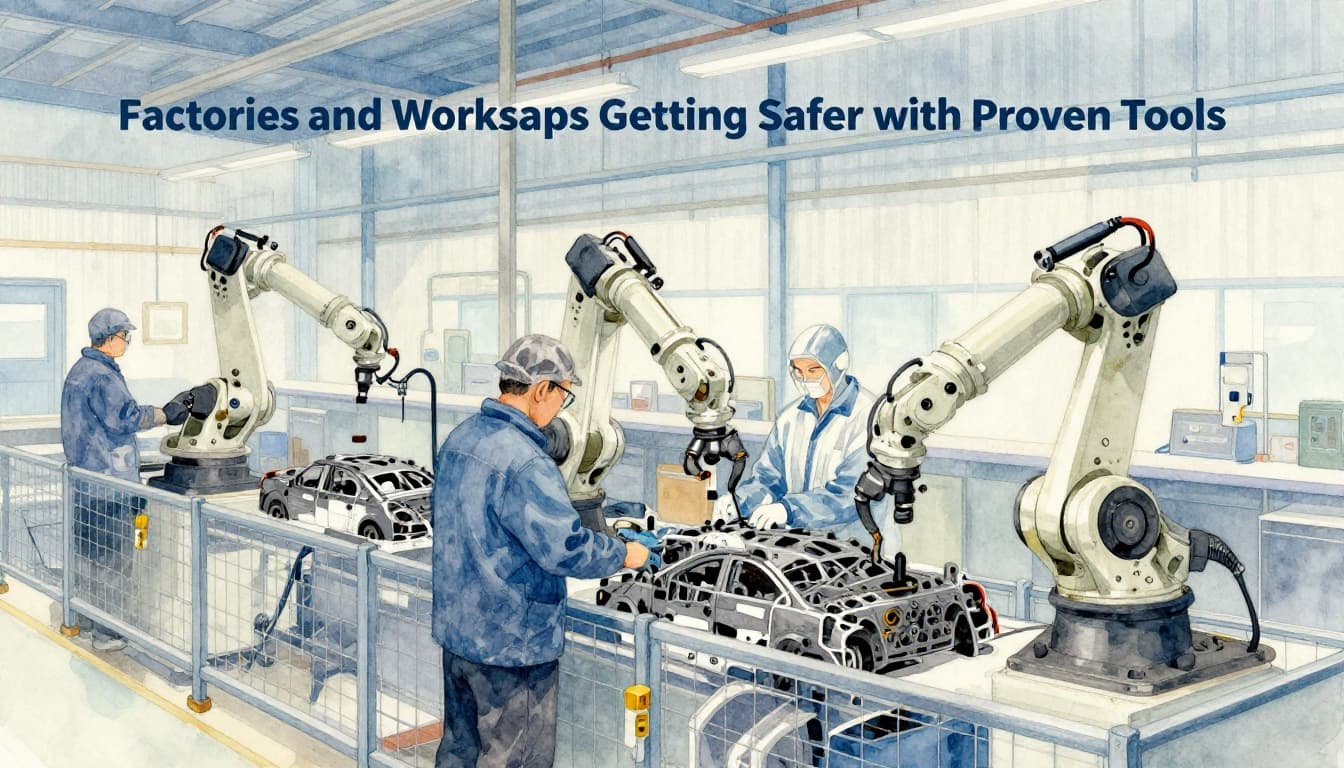
Factories and Workshops Getting Safer with Proven Tools
Factories don’t just need better machines. They need better ways to manage risk.
In many plants, standards improve safety by forcing clear rules on machine guarding, lockout and tagout, inspection points, and training records. Standards also reduce quality loss by defining acceptance criteria up front.
When automation enters the mix, the safety story changes again. Standards help because they treat robot safety as a full system. You plan for how workers move, where hazards exist, and how controls work together.
Also, safety rules shape how teams respond when something goes wrong. Instead of “don’t let it happen again,” standards require root cause thinking and documented correction. That creates learning you can repeat across teams.
If you’ve ever watched how a shop handles a near miss, you can feel the difference. Strong standards turn near misses into improvements, not blame.
Healthcare and Food Keeping People Healthy Daily
In healthcare, quality isn’t only about clean rooms. It’s also about preventing repeat mistakes.
Standards push healthcare teams to find root causes. Then they build controls that stop the same failure from returning. That can mean better handoff rules, improved labeling steps, and more reliable reporting. The goal stays simple: safer care and fewer preventable events.
Food safety works the same way, but with different hazards. Standards focus on prevention across the supply chain. They require hazard analysis, control points, and traceability.
A widely used framework is ISO 22000, which follows HACCP-style logic. It helps food businesses manage food safety risks throughout the chain. For a clear explanation of how it affects real food operations, see the impact of ISO 22000 on food safety management.

When teams treat food safety as a managed system, the whole process gets steadier. That reduces contamination risk and improves consistency across batches.
Aviation and Toys Protecting Us Where It Counts Most
Aviation is where safety standards face zero excuses. You can’t “wing it” at 30,000 feet.
The FAA uses safety programs that encourage reporting and continuous improvement. For example, the Aviation Safety Action Program (ASAP) aims to enhance safety by encouraging voluntary reporting of safety issues and events that come up in day-to-day work. Learn more about FAA Aviation Safety Action Program (ASAP).
That reporting matters because it turns “we noticed something” into actionable fixes. Then the industry learns as a group, not as isolated crews.
Now switch to toys. Toys look simple until you think about kids putting everything in their mouths.
In the U.S., CPSIA requirements drive testing and compliance steps that help limit harmful chemicals in children’s products. Testing often involves chemical checks to confirm materials meet the limits. If you’re curious about how CPSIA testing works in practice, see CPSIA testing and compliance for children’s toys.
When standards like these operate well, parents feel more confident. Kids stay safer. Companies also avoid the costly fallout of recalls.
Standards protect you most when risk is highest. Next, let’s talk about the big payoffs, including money, time, and safer workplaces.
The Big Payoffs: Savings, Stats, and a Safer Future
Standards improve safety and quality in ways that show up on balance sheets and in injury reports.
First, safety. Recent U.S. tracking shows fatalities fell from 5,283 in 2023 to 5,070 in 2024. That’s a drop in the fatality rate too, from about 3.5 to 3.3 deaths per 100 full-time workers. Injuries and illnesses also declined in reported totals and rates.
Those numbers don’t prove standards alone caused every improvement. Yet the pattern fits what standards are designed to do: reduce exposure, improve controls, and catch problems earlier. OSHA enforcement and planned safety management work together with these systems.
Second, cost. Defects create costs in three places: materials, labor, and time. Then they add downstream costs like returns and warranty claims. Standards reduce the number of surprises. That cuts scrap and rework.
Third, trust. Customers and business partners want proof. Certifications and consistent performance help organizations win contracts, reduce friction in audits, and build long-term relationships.
Finally, standards support the next wave of change. As of March 2026, work on updates is already underway. ISO 9001:2026 is in draft form, with expected release later in 2026. ISO 45001 is heading toward a 2027 update (a tune-up rather than a major rewrite). Meanwhile, OSHA’s safety focus is also shifting toward system-level robot and AI-related safety expectations.
That matters because the world keeps changing. Standards give you a reliable foundation while rules evolve with new risks.
When standards get applied well, you don’t just meet the minimum. You build a culture where safety and quality stay in sync.
Conclusion
Standards improve safety by turning risk control into repeatable work. They also improve quality by reducing variation, strengthening inspections, and keeping improvements on a schedule.
You saw how this shows up in real settings, from manufacturing and electronics to food handling and aviation safety programs. You also saw the business side: fewer failures mean less waste, and better controls mean fewer serious injuries.
So here’s the question from the opening hook: when you buy or build, do you rely on luck, or do you demand proof? Ready to demand standards everywhere? Start by checking certifications, asking how audits work, and pushing for safer, more consistent processes at work.