A compliance failure can feel like a surprise storm. One week you’re operating normally, and the next you’re facing requests for evidence and possible fines.
That’s where audits come in. Audits prove compliance with standards by checking whether your processes, records, and controls match what the rules require. When you do it well, you reduce risk, spot gaps early, and build trust with regulators, customers, and business partners.
Think of an audit like a well-lit inspection of your whole system. Instead of relying on claims, it looks for proof. It tests real work, then documents what’s working and what needs fixing. After that, it tracks whether changes actually happened.
In the sections below, you’ll see the clear audit steps teams use to check compliance, the tools and evidence methods that make findings credible, and the standards audits commonly cover (like ISO 27001, GDPR, and SOX). You’ll also get the real wins audits deliver, plus common pitfalls to avoid. Finally, you’ll see audit trends shaping compliance in March 2026, including more AI use and continuous monitoring.
The Clear Steps Audits Follow to Check Compliance
Most audits follow a repeatable flow. That repeatability matters because it keeps results fair and helps you compare findings over time. Even so, each audit still adapts to your risk, your industry, and the standard you’re meeting.
Here’s the roadmap auditors use to prove compliance, step by step.

Planning Ahead to Target the Biggest Risks
Good audits start before anyone opens a folder. In the planning phase, the audit team sets goals and decides where to focus. If auditors spend time on low-risk areas first, the audit drags on. So they usually work in priority order.
Planning typically covers:
- Audit scope (what systems, sites, teams, or time period are included)
- Risk thinking (where failures would cause harm, fines, or major reporting errors)
- Audit criteria (which standards, policies, or laws define “compliant”)
- Team selection (skills needed, like IT security or financial controls)
- Evidence approach (what proof will count, and how it will be collected)
Then auditors build a plan they can actually execute. That plan often includes checklists and a schedule for interviews, tests, and document review.
One practical example: if your company claims it meets SOX internal control rules, auditors don’t just read the policy. They plan which financial logs to sample and which control owners to interview.
Before the audit starts, preparation helps a lot. You don’t need to “panic clean.” Instead, get organized and reduce chaos:
- Lock down your evidence location (one place, not five spreadsheets in email)
- List control owners and backups (so interviews don’t stall)
- Collect “as-is” records (the real versions used at work time)
- Write down key changes (auditors ask, even if you think they won’t)
When audits are planned well, each later step makes sense. Evidence collection won’t feel random. Testing won’t feel like guesswork.
Testing Controls with Real-World Checks
After planning, auditors gather evidence and test whether controls work in practice. This is the part many teams feel most. But it’s also where compliance becomes real, not just written.
Testing commonly uses three evidence styles:
First, document and record review. Auditors inspect procedures, logs, tickets, approvals, training records, and monitoring reports. They’re looking for completeness and consistency.
Next, people-based evidence. Interviews test whether control owners actually understand their duties. Auditors also ask for examples. If a manager can’t explain their control, that gap matters.
Finally, practical verification. Auditors may observe work, shadow a process, or run sample checks. In IT, that can mean checking access logs, change history, or data handling controls.
Here’s how this can look in SOX: auditors might sample journal entry approvals and then compare them against financial system logs. If approvals exist on paper but don’t appear in the system records, the control may not work.
For teams mapping controls to SOX testing, this SOX Section 404 guide can help you see how auditors structure controls and testing: SOX Section 404 compliance checklist.
The key is repeatability. Auditors don’t “interpret” a control into compliance. They check the control, then check the evidence, then document whether it passes.
Reporting and Fixing What You Find
An audit report isn’t the finish line. It’s the moment where facts become decisions.
A solid report typically includes:
- What auditors reviewed (scope and time period)
- What’s strong (so you don’t lose good work)
- What’s not meeting criteria (findings, with evidence)
- Impact and risk rating (how bad it could be)
- Corrective actions (what changes, who owns it, and by when)
When the report is clear, teams can act fast. When it’s vague, fixes become debates instead of progress.
Also, smart audits track follow-through. That follow-up can include re-testing controls, checking whether policies updated, or verifying that new logs reflect the improved process.
A helpful way to think about it: audits turn “we think we comply” into “we can show compliance.” Then follow-up turns “we planned to fix it” into “we fixed it.”
Smart Tools Auditors Use to Spot Rule Breakers
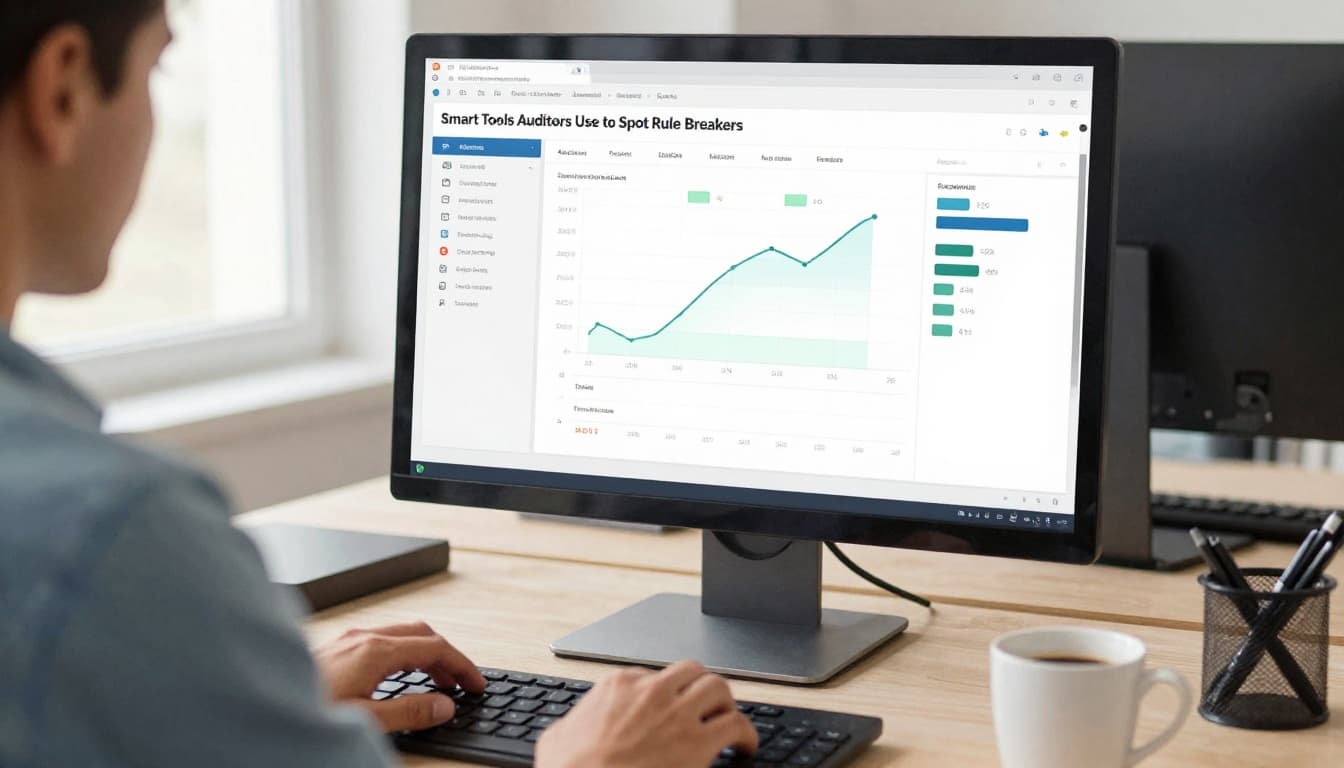
Audits need evidence. Evidence needs storage, retrieval, and traceability. That’s where tools come in.
Some tools support the audit directly. Others support the compliance system behind the audit. Either way, the goal stays the same: create proof trails and reduce blind spots.
From Paper Trails to Tech Scans
Traditional audits rely heavily on paper and spreadsheets. Auditors request documents, scan records, and manually verify samples. This can work, but it takes time. It also increases the risk of missing something when the dataset is huge.
Modern audits often mix classic checks with tech scans. For example:
- Control testing dashboards show which evidence exists, which is missing, and which controls didn’t run on schedule
- System log analysis highlights unusual access patterns, failed approvals, or unexpected changes
- Workflow tracking proves who approved what, and when
- Risk registers help auditors focus where failures would matter most
Some teams also use tools that support evidence collection and organization. Even when AI is used, auditors still validate output. They treat models as helpers, not final judges.
The big benefit of audit tech is consistency. You get fewer “lost in email” moments. You also get faster proof retrieval when a regulator asks a direct question.
Top Standards Audits Help You Nail Every Time
Different standards target different risks. But the audit logic stays similar. Auditors compare your actual controls to the standard’s requirements, then document whether you meet them.
Here are common standards and how audits test them.
| Standard | What it focuses on | What audits typically verify |
|---|---|---|
| ISO/IEC 27001 | Information security management systems (ISMS) | Policies, risk management, control execution, internal audits |
| GDPR | Data privacy and protection | Lawful processing, access controls, breach response, vendor oversight |
| SOX | Financial reporting controls | Internal controls, approvals, change management for reporting systems |
| HIPAA | Health data privacy and security | Access controls, risk analysis, safeguards for PHI |
| SOC 2 | Service provider control environment | Security, availability, confidentiality, processing integrity |
| OSHA | Workplace safety | Training, hazard controls, incident tracking, compliance logs |
Navigating Data Rules Like GDPR and HIPAA
Privacy audits look different from financial audits. Instead of testing approvals for numbers, auditors test how you handle information and how you prove your handling decisions.
For GDPR, auditors often check:
- Access and purpose limits (who can see data, and why)
- Retention rules (how long you keep personal data)
- Privacy notices and rights support (how you handle requests)
- Vendor and transfer controls (whether third parties follow your rules)
- Breach response readiness (plans, testing, and records)
If your team wants a practical starting point, this GDPR compliance checklist guide can help organize common audit checks: GDPR compliance checklist guide.
For HIPAA, audits often focus on the safeguards around protected health information (PHI). That includes access control, staff training, audit controls, and risk management. In many organizations, the hardest part is not the policy. It’s proving staff follow the policy during day-to-day work.
Also, auditors pay attention to how you handle incidents. If your team doesn’t document what happened, when, and what changed, it’s hard to show accountability.
Financial and Security Checks for SOX and ISO
SOX audits focus on financial truth and internal control strength. Auditors verify that controls prevent or detect misstatements. They also want evidence that management reviews key controls.
A common audit pattern includes:
- Testing approval workflows (who signed off, and whether it happened)
- Sampling transaction records
- Checking change control for reporting systems
- Reviewing reconciliations and supporting records
ISO/IEC 27001 audits focus on your security management system. It’s not only “do you have tools.” It’s “do you manage risk and improve over time.”
For reference, the official ISO overview of ISO/IEC 27001:2022 is here: ISO/IEC 27001:2022 information security management systems.
In practice, auditors look for how your ISMS handles risk. They also check whether internal audits happen and whether management reviews results.
When you pass these audits, it doesn’t just satisfy requirements. It also reduces the chance of security gaps and reporting errors.
Real Wins from Audits Plus Pitfalls to Dodge
Audits help businesses in ways you feel quickly. You find weak points before they turn into violations. You improve processes because you fix real problems, not guess what’s wrong.
Here are common wins teams report:
- Faster fixes because findings point to specific evidence gaps
- Better trust with leadership, regulators, and outside auditors
- Clearer ownership since control duties get named and tracked
- More stable processes because controls run on a schedule
- Improved efficiency once evidence is centralized
However, audits can also go sideways. The most common pitfalls are usually human and practical, not technical.
Time and effort can balloon if scope is unclear. Staff buy-in often drops if teams fear blame. Scattered data makes sampling slow. Also, standards do change, so your controls can drift out of date.
A few practical ways to reduce stress:
- Run a “mock audit” on one process each quarter
- Assign a single evidence owner per control group
- Keep an issues log that tracks findings and fixes
- Update control documentation when workflows change
If you treat audits like a one-time event, they feel painful. If you treat them like a repeating system, they feel more like maintenance.
Audit Trends Shaping Compliance in 2026
Compliance audits in 2026 aren’t just about once-a-year checkups. Many teams now aim for more frequent evidence, more continuous checks, and better coverage across vendors.
Three trends show up again and again:
First, AI use in audit work. Teams use AI to help summarize evidence, flag anomalies, and support risk scoring. Still, final conclusions need human validation. Regulators and customers expect real proof.
Second, continuous auditing. Instead of waiting for a yearly audit, some organizations run control checks all month. Dashboards track evidence, control execution, and changes. That reduces the “scramble” when an auditor arrives.
Third, vendor and ecosystem audits. After high-profile incidents, organizations scrutinize third parties more closely. So audits expand beyond internal teams.
At the same time, regulatory pressure keeps shifting. In the US, you’ll see more focus on areas like financial crime compliance, beneficial ownership reporting changes, and additional governance for emerging tech.
If you want a view of how auditing itself is evolving, this set of 2026 audit trends is a useful read: audit trends to watch in 2026.
The takeaway is simple. Audits are becoming more frequent, more automated in evidence collection, and more tied to risk. That means your best move is to keep your controls running and your evidence organized.
Conclusion: Audits Turn Standards Into Proof
When you ask how audits ensure compliance with standards, the real answer is evidence and follow-through. Auditors plan for risk, collect credible proof, test controls in real settings, and report findings clearly.
Then the next part matters most. You don’t just fix issues once, you re-check and improve so compliance stays steady.
If you want an action step, schedule a focused audit review for one high-risk process this month. Or run a mock audit with the same evidence you’d show a real auditor.
What’s the toughest part of compliance for you right now, evidence gathering, staff buy-in, or keeping up with changing rules?