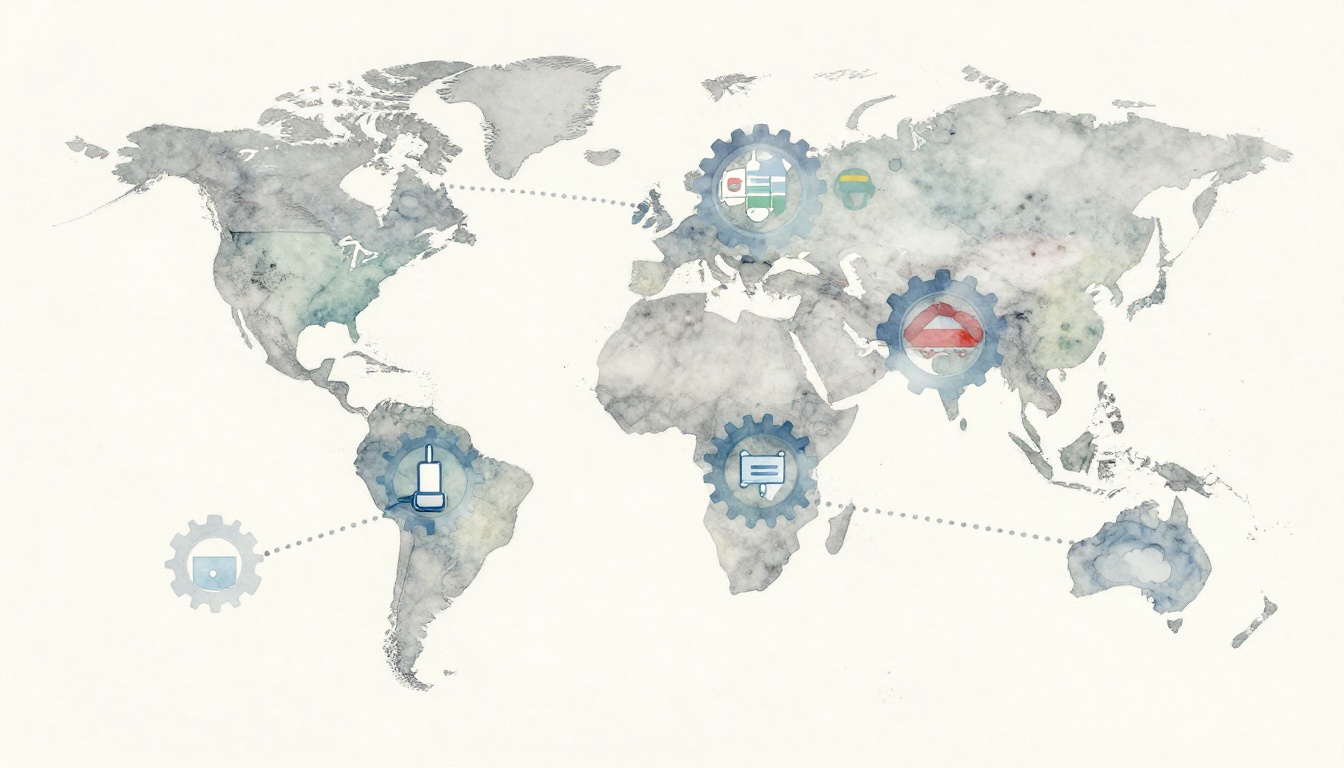
Ever bought a charger or toy that worked fine at home, then hit a wall after crossing a border? Standards explain a lot of that friction.
Standards are rules and technical requirements for safety, quality, and performance. They also cover how tech should work together. In other words, they help products avoid harm and work as intended.
So why do rules feel different from country to country? Often, it comes down to who runs the system. Some places rely more on market-led groups. Others lean on government-led control. And in 2026, AI, data rules, and geopolitics keep pushing standards in new directions.
Now let’s break down the main approaches, and what they mean for businesses trying to sell across borders.
Market-Driven Standards: Flexibility in the US, EU, Japan, and Australia
In market-driven systems, standards usually come from a mix of industry groups, testing labs, and regulators. That can speed up updates, because companies need answers fast. It also helps products move across borders when rules line up with global references like ISO/IEC.
Still, “market-led” does not mean “no enforcement.” Regulators often require certain levels of safety. They just may not write every technical rule from scratch.
A good way to think about it is like building a house with agreed blueprints. Industry drafts many details. Government checks the parts that protect people.
United States: Private Sector Takes the Wheel
In the US, private groups strongly influence standards work, and government agencies focus on enforcement and public safety. A key coordination role comes from ANSI, the American National Standards Institute. It helps align many US standards with broader international effort.
For technology and measurement, NIST plays a central role in standards strategy and national metrology. You can see this reflected in NIST’s policy work on the US approach to standards United States Standards Strategy Released.
Then there’s the enforcement side. Agencies like OSHA handle workplace safety. That means the US often enforces “outcomes” (safe operation, compliant products) while leaving “how to meet the outcome” to standards organizations and industry consensus.
This approach can help exporters in two ways. First, updates often happen in step with global technology. Second, US sellers can often map their product to international frameworks like ISO/IEC and then meet specific US requirements.
For example, think about an electrical product such as a phone charger. A company may design to an international safety standard first. Then it adjusts for local labeling, testing expectations, and any enforcement rules. If the country follows a global base, the adjustment work can be smaller.
If you want a quick grounding in how ANSI fits in, here’s an accessible overview from Machinery Safety 101: 5 Things You Need to Know About ANSI.
Bottom line: US buyers often expect products to meet recognized standards quickly, because the system supports industry-led alignment.
EU and Australia’s Seamless Global Fit
The EU takes a different route, but it still aims at a strong fit with wider trade. In many cases, EU policy pushes toward harmonized standards that help goods move more easily inside Europe and beyond.
Two bodies frequently show up in EU standardization: CEN and CENELEC. They create and maintain many European standards that support consumer safety and industry compliance. For instance, CEN-CENELEC work on consumer and child-focused products, including toys and safety hazards, through dedicated technical committees. See Child Safety Products – CEN-CENELEC.
Meanwhile, the broader consumer scope explains why these standards matter for everyday goods, not only specialized equipment. CEN-CENELEC describes how European Standards support safety requirements for products used by or accessible to consumers. That page is here: Consumer – CEN-CENELEC.
Australia often mirrors the “global fit” idea through AS/NZS standards. Australia usually values alignment with international references, then adds local requirements where needed. For many products, that means fewer surprises for companies that already build to global safety and performance baselines.
Also, both regions tend to care a lot about consumer protection. That can mean more structured compliance steps. It can also mean a clearer path for firms that document testing well.
A simple analogy works here. If US standards feel like a set of modular blocks, EU standards feel like those blocks arranged to meet building codes across many states. Australia often follows the modular approach too, but with local glue and labeling rules.
Bottom line: EU and Australia often push for recognized safety and performance benchmarks, which can reduce friction for exporters.
Japan’s Balanced Tech Cooperation
Japan is often described as cooperative on tech standards. Industry input matters, but government ministries also shape priorities, especially in telecom, electronics, and industrial safety.
Japan uses standards development through JIS work, often coordinated through the national standardization process. At the same time, Japan tends to align many technical needs with international references. That helps Japanese products sell globally, and it helps foreign products meet expectations in Japan.
You’ll often see two layers in play. First, the base technical requirements come from widely accepted frameworks. Next, Japan applies specific adjustments where it has strong domestic experience, such as certain testing methods, performance expectations, or regulatory details.
That balance helps in fast-moving categories. Consider semiconductors and wireless components. The technology evolves quickly. If standards lag behind, firms spend extra time re-testing. Japan’s approach often aims to keep updates moving while still protecting reliability.
In practice, you can expect Japan to be detail-oriented about documentation. If your test report is clear, your compliance story usually becomes simpler.
Bottom line: Japan often builds standards around international cooperation, then adds targeted local detail.
State-Controlled Systems: Strict Rules in China, India, and Brazil
When governments play a larger role, standards can become stricter and more centralized. That can protect local consumers and local industry. It can also slow down market entry.
In these systems, you usually see more mandatory conformity routes. That means tests, registrations, or approvals that you can’t “skip” by meeting only international standards.
Here’s the trade-off. Local authorities may gain more control and predictability. Exporters may face more paperwork, more rounds of testing, and longer timelines.
China’s National First Push
China’s approach often puts national standards first. China also uses mandatory certification schemes for many product categories, especially where safety or quality risks are higher.
One of the most well-known routes is CCC, which stands for China Compulsory Certification. For importers and manufacturers, CCC can act like a gate. If a product category falls under CCC, you need the right approvals before you sell.
You can see how CCC functions as a mandatory system in this guide from ECQA: China CCC Certification Guide. It explains that CCC covers certain products sold, imported, or used commercially in China. It also describes how the system functions as a compliance and testing requirement.
China also relies on national technical standards (often called GB standards). In many cases, international standards can help during development. But certification still focuses on the national rule set and the testing evidence required by Chinese schemes.
There’s also a practical reality. China’s system may involve more factory checks, sampling tests, and document review. That means exporters often need local support and clear product mapping early.
AI-driven devices are adding another layer too. Regulators may ask how a product collects data, connects to networks, or handles safety risks related to software behavior. Those needs can shift quickly as rules catch up with new tech.
Bottom line: China often rewards early compliance planning and strong documentation, because certification is usually non-negotiable.
India and Brazil’s Local Protection Focus
India and Brazil also use heavier national control in many sectors. The goal is often consumer safety, quality assurance, and support for local standards compliance.
In India, BIS manages many product standards and certification pathways. For products under mandatory regimes, firms must follow those requirements to sell legally. You can start with BIS’s official page on Products under Compulsory Certification. It outlines the compulsory certification approach and points buyers toward the standards set that applies.
The practical challenge is timing. If your product category is in the compulsory list, you may need testing and approvals before importation or sale. That can slow down launch cycles compared with countries where standards are mostly “voluntary guidance plus enforcement.”
Brazil often uses a similar “approval first” feeling in regulated categories. For wireless and telecom equipment, ANATEL approvals can be required. For broader consumer and industrial product safety, INMETRO can drive certification requirements.
This guide explains how certification pathways may work for Brazil, including the split between INMETRO and ANATEL: INMETRO and ANATEL regulations for Brazil. It also highlights that telecom and radio-frequency devices often face special requirements.
Brazil can also be selective in how it adopts international rules. When local requirements differ, exporters may need country-specific testing. That increases cost, but it can also reduce uncertainty once compliance is done.
Bottom line: India and Brazil often protect local compliance rules through mandatory certification, so exporters should plan longer timelines.
Global vs Local Standards: Who Wins at ISO and IEC Harmony?
If you’re selling worldwide, you probably want the simplest question possible: “Can I build once and sell everywhere?”
The answer depends on how each country treats international standards like ISO and IEC.
In many market-driven systems, companies can adopt ISO/IEC frameworks faster. Then they adjust only what local regulators require. In state-controlled systems, national rules may take priority. Even if ISO/IEC influenced the thinking, the certification process may still require national evidence.
Here’s a quick side-by-side view.
| Approach type | Who leads standards | Typical export impact | Common friction |
|---|---|---|---|
| Market-driven (US, Japan, Australia) | Industry consensus with regulator enforcement | Faster mapping to international baselines | More interpretation across agencies |
| EU harmonization | CEN/CENELEC standards supporting EU rules | Clear compliance route for many product types | Mandatory conformity steps by directive |
| State-controlled (China, India, Brazil) | Government-led certification and national rules | Slower entry, more paperwork | Mandatory certification timelines and local tests |
| Hybrid reality | Both industry and government shape rules | Best-case “build once” varies by category | Software rules and telecom rules change often |
The strongest advantage in the market-driven and EU model is interoperability. If your product talks the same technical language everywhere, it’s easier to sell and service.
The strongest advantage in state-controlled models is predictable national coverage. Authorities often know exactly what they want. But exporters must match those requirements, not just “good enough” international testing.
One more reality check: standards are no longer only hardware. For software-heavy products, countries increasingly care about behavior, data handling, and safety impacts from software features. That makes global alignment harder.
Bottom line: ISO/IEC harmony is possible, but you still need a country-by-country compliance plan.
2026 Shifts: Geopolitics and Tech Driving Standards Changes
In 2026, standards keep changing because tech keeps changing. AI, advanced batteries, and connected devices are pushing regulators to ask new questions.
First, AI adds risk in new ways. Not every AI risk looks like a classic “electrical safety” problem. Some risks involve data privacy, cybersecurity, and model behavior that affects real-world safety.
Second, geopolitics affects supply chains and approvals. When trade ties tighten, countries may push for clearer local conformity routes. Even if they reference ISO/IEC, they may require local testing evidence or local representatives for market access.
Third, semiconductors and telecom hardware face special attention. Governments care about security and network reliability. That can show up as stricter controls, more audits, or longer reviews for certain device categories.
Fourth, the EU and the US both keep expanding rules around new tech categories, including AI-related safety and risk management. That can cascade into product testing expectations for companies building smart devices for the EU or US markets.
Meanwhile, China, India, and Brazil often update national standards to match local policy goals. That can mean new certification scopes, refreshed test requirements, or altered documentation rules.
So how should businesses respond in practical terms? Start with a simple routine:
- Identify your product category early (safety, telecom, battery, software, toys, medical, and so on).
- Find the controlling standard path in each target country.
- Map your current test reports to those requirements.
- Plan for updates, because 2026 changes can hit faster than your design cycle.
If you sell chargers, toys, or consumer electronics, this approach matters even more now. A small change in a connector type or power profile can trigger new testing needs.
Bottom line: In 2026, standards change because risk changes, and risk now includes software and geopolitics.
Conclusion: The Real Difference Is Who Sets the Rules
Countries differ because they want different balances between safety, trade, and local control. Market-driven systems often move faster toward global alignment, which can help exporters reduce extra testing. State-controlled systems can be stricter and slower, but they deliver clear national requirements once you’re in.
The best strategy is not to guess. Check the right standards bodies early, then build to international references where possible. And if your product hits China, India, or Brazil, treat certification timelines as part of your launch plan.
If your last compliance headache came from one country rule that didn’t match another, you’re not alone. Which country caused the biggest surprise for your product, and what requirement caught you off guard?